
Gurudev Sri Sri Ravi Shankar at SPIEF 2026: Championing Wellness, Culture, and Human Values for Sustainable Economic Growth
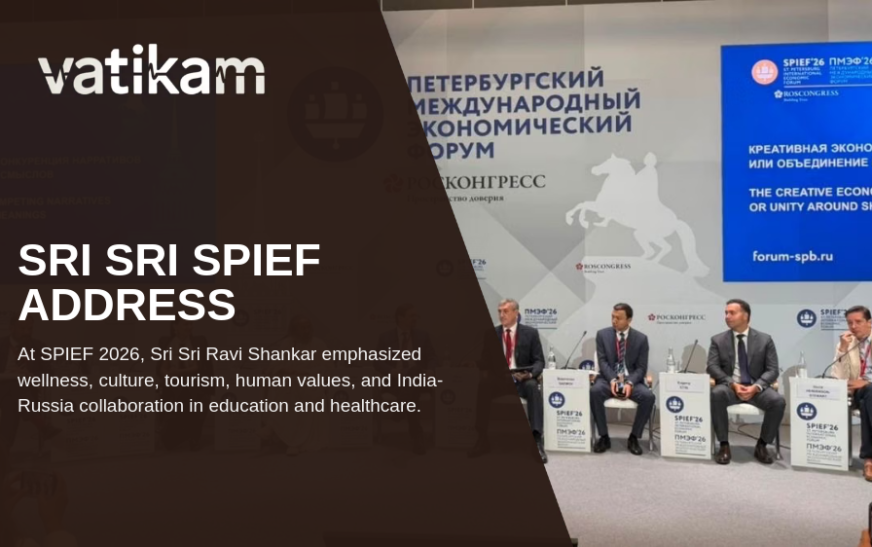
Bengaluru: In a groundbreaking address at the St. Petersburg International Economic Forum (SPIEF) 2026, global spiritual leader Gurudev Sri Sri Ravi Shankar spotlighted the crucial role of wellness, culture, and human values in shaping the future of global economies. Held under the auspices of Russian President Vladimir Putin, the forum gathered visionary leaders to discuss the multifaceted drivers of economic growth in an increasingly interconnected world.
The New Paradigm: Wellness and Human Values in Economic Growth
Gurudev Sri Sri Ravi Shankar’s participation at SPIEF marks a pivotal shift in global economic narratives. Traditionally dominated by themes such as investment, innovation, and technology like artificial intelligence, the conversation is expanding to include the foundational pillars of mental wellbeing, social trust, and cultural connectivity as core components of sustainable prosperity.
Highlighting the alarming global rise in mental health challenges—with one in four individuals facing psychological issues—Gurudev emphasized wellness as a central economic priority. He noted India’s pioneering role through its ancient systems of yoga, Ayurveda, and traditional preventive healthcare, underscored by the establishment of the Ayush Ministry by Prime Minister Narendra Modi to promote holistic wellness worldwide.
India-Russia Collaboration in Wellness and Education
Building on the shared interest and strengths of both India and Russia in wellness practices, Gurudev advocated for deeper bilateral cooperation. He identified tourism, wellness, and student exchange programs as key sectors ripe for expansion that could foster stronger people-to-people ties and unlock fresh economic opportunities.
Gurudev underscored the recent memorandum of understanding between Sri Sri University in Odisha and Ural Federal University in Yekaterinburg as a model for educational partnership. He emphasized the role of universities as nurturing grounds for fostering enduring India-Russia relations through language, culture, and academic exchange.
Cultural Exchange: A Catalyst for Social Cohesion and Economic Vitality
In his address, Gurudev challenged the conventional view of culture as mere entertainment or heritage, proposing instead its powerful role in driving social cohesion, economic dynamism, and international understanding.
Drawing from two decades of organizing the World Culture Festival—one of the largest celebrations of cultural diversity globally—he showcased how music, art, food, and shared experiences bridge divides even among communities in conflict. Events held from Germany’s Olympic Stadium to New Delhi, featuring millions of participants and tens of thousands of artists, exemplify cultural engagement’s power to promote tourism, support local economies, and foster global unity.
“People from different countries came together, discovered new music and traditions, and bonded like family,” Gurudev noted, emphasizing the democratized nature of these festivals, where artists from diverse backgrounds showcase their talents on an inclusive international platform.
Building Happier, More Inclusive Societies
Gurudev advocated for the encouragement of non-competitive cultural activities as a means of creating happier and more inclusive societies. He also announced the creation of the World Forum for Art and Culture—a global initiative akin to the Olympics but focused on art and cultural exchange, celebrating creativity beyond competition.
Engagement with Influential Policy Makers and Industry Leaders
The forum featured distinguished participants such as Denis Alipov, Ambassador of Russia to India; Vinay Kumar, Indian Ambassador to Russia; Sergey Cheremin, Moscow government minister; Alexey Chekunkov, Russian Minister for the Development of the Far East and Arctic; and Vasily Orlov, Governor of the Amur Region, among others.
Together, they discussed innovative frameworks for sustainable development that balance technological advancement with human-centric values like trust, creativity, and cultural harmony.
Conclusion: A Holistic Vision for Future Economies
As the global community seeks new models for sustainable economic development, Gurudev Sri Sri Ravi Shankar’s insights at SPIEF 2026 offer a timely and holistic vision. They remind policymakers and business leaders alike that the most enduring economies are those that nurture human well-being, celebrate cultural diversity, and foster deep connections across borders.
By integrating wellness, culture, and shared human values into economic strategies, nations not only enhance prosperity but also build resilient, vibrant societies prepared to thrive in an interconnected world.