
AI and Healthcare: Are Doctors Losing Their Skills Due to Over-Reliance on AI?
Artificial Intelligence (AI) is transforming healthcare with unprecedented speed, assisting doctors in diagnostics and treatment decisions. However, while AI offers many benefits, recent studies reveal an emerging concern: a significant number of healthcare professionals fear they are losing essential skills due to over-reliance on AI technology.
Impact of AI on Clinical Skills: What Studies Show
A 2025 study published in The Lancet Gastroenterology & Hepatology highlighted a troubling trend among doctors using AI for colonoscopies. Physicians assisted by AI to detect polyps—a key indicator of potential cancer—later demonstrated a decline in their ability to identify polyps without AI. Their adenoma detection rate dropped by six percentage points after adopting AI tools.
Before AI integration, doctors detected adenomas in 28.4% of colonoscopies. This rate fell to 22.4% when performing colonoscopies without AI assistance post-adoption, despite these doctors having vast prior experience of over 2,000 procedures.
The Growing Dependence on AI in Healthcare
Data paints a clear picture of growing AI utilization in healthcare settings. Between 2025 and 2026, the use of AI by doctors nearly quadrupled from 10% to 38%. Similarly, AI use among nurses increased from 16% to 32% in the same timeframe.
However, this escalating reliance carries a paradoxical downside—clinicians are experiencing ‘deskilling.’ The more they outsource diagnostic tasks to AI, the more their intrinsic skills atrophy, leaving them less capable of making independent clinical judgments.
What is Deskilling?
Deskilling refers to the degradation of a professional’s ability to perform tasks manually due to heavy dependence on automated systems. A 2026 study by Anthropic Research revealed that although AI delegation enhances speed and efficiency, it often comes at the cost of practical skill retention—highlighting crucial implications, especially in healthcare where human expertise is paramount.
Healthcare Workers’ Concerns: Survey Insights
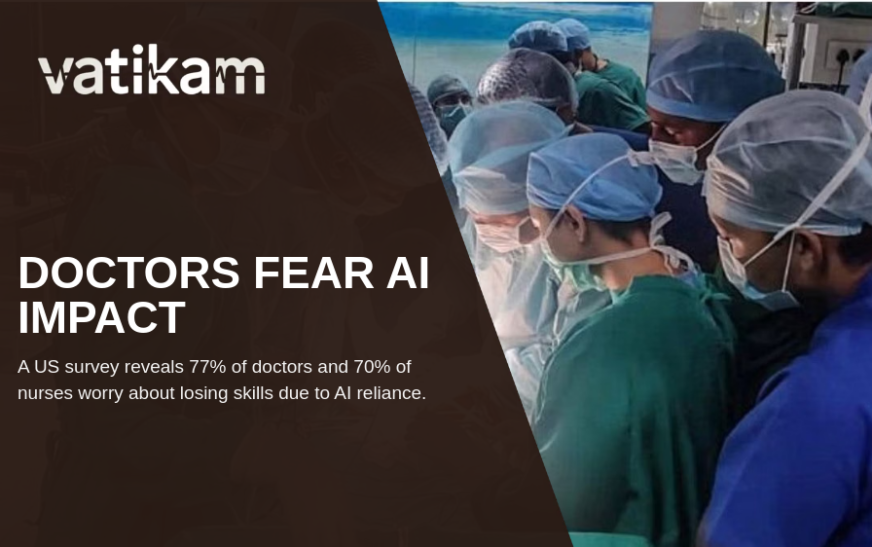
A recent U.S. survey found that 77% of physicians and 70% of nurses expressed concern about losing key clinical skills due to over-reliance on AI systems. This reveals a widespread apprehension about the future balance between AI assistance and hands-on medical expertise.
On a positive note, many clinicians remain vigilant. The survey reported that 77% of healthcare workers cross-check AI-generated information against trusted sources such as PubMed or UpToDate to ensure accuracy and maintain clinical rigor.
The Changing Role of Patients in the AI Era
Patients have increasingly become active participants in their health management by using AI tools for self-education. More than half of patients now research their medical conditions or medication side effects using AI before consulting doctors. Nearly 60% of patients reported that their doctors discuss AI-derived information openly during consultations.
Doctor-patient interactions have thus evolved into fact-checking sessions, where both parties examine AI-generated content critically. About 56% of doctors review AI information brought by patients, clarifying how it aligns—or sometimes conflicts—with evidence-based clinical guidelines.
Balancing AI Use with Skill Retention: The Path Forward
AI undoubtedly enhances healthcare delivery and increases awareness among patients and clinicians alike. Both groups—around 70% each—agree that AI improves health literacy and engagement.
Nevertheless, challenges remain due to the current lack of comprehensive safeguards and guidelines regulating AI use in medicine. Experts urge healthcare professionals to consciously reflect on which competencies should be preserved and which may be safely delegated to AI.
Kevin Crowston, an information scientist at Syracuse University, emphasizes the need for self-awareness among clinicians about their skill retention versus outsourcing choices, fostering a balanced integration of AI without compromising critical expertise.
Conclusion
As AI continues to permeate healthcare, it is vital to address the paradox of improved efficiency vs. skill erosion. While AI assistance offers tremendous potential to aid diagnosis and treatment, healthcare providers must actively safeguard their clinical skills to maintain high standards of patient care. Building AI literacy alongside preserving hands-on expertise will define the future of medical professionalism.
For healthcare systems globally, nurturing this balance through training, policy, and technology design is essential to harness AI’s benefits without undermining the invaluable human element of medicine.