

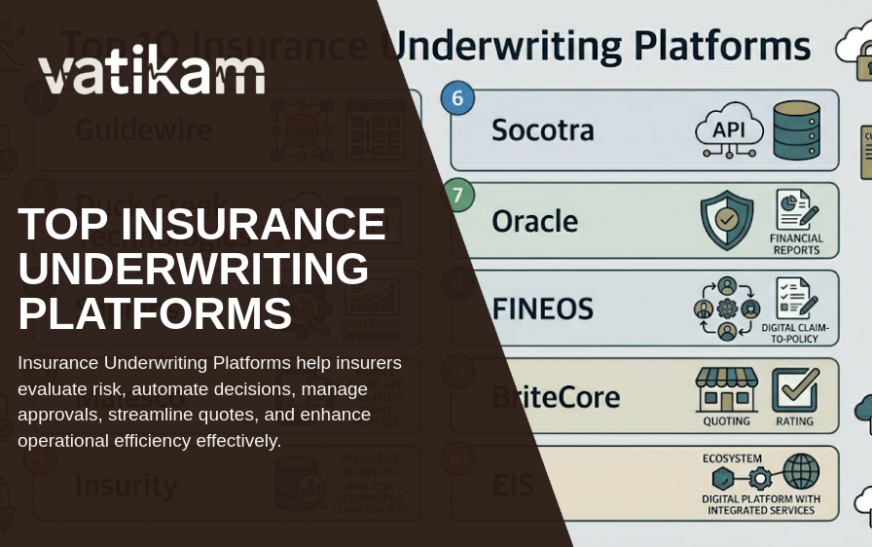
Top 10 Insurance Underwriting Platforms: Features, Benefits & Comparison
Insurance underwriting platforms have revolutionized how insurers evaluate risk, automate decisions, and streamline policy approvals. By centralizing digital workflows, these platforms improve operational efficiency, enhance underwriting accuracy, and accelerate policy issuance. Whether you’re a property and casualty insurer, life or health insurance provider, MGA, or specialty carrier, the right underwriting platform is essential for modernization and scalable growth.
What Are Insurance Underwriting Platforms?
Insurance underwriting platforms are software systems designed to support insurers in risk evaluation, underwriting automation, quote generation, and policy management. Modern platforms integrate advanced AI-driven risk scoring, workflow automation, analytics dashboards, and flexible API integrations to create a unified environment that enhances underwriting speed and accuracy.
Key Features of Modern Underwriting Platforms
- Automated underwriting workflows
- AI-driven risk assessment and scoring
- Product configuration and quote generation
- Integration with claims, billing, and CRM systems
- Comprehensive reporting and analytics dashboards
- Cloud-native deployment for scalability and flexibility
- Strong security and compliance controls including encryption and audit logs
- Customer and broker communication tools
- Customizable workflows and operational usability
Top 10 Insurance Underwriting Platforms
1. Guidewire
Best for: Enterprise property and casualty insurers
Guidewire offers comprehensive underwriting and policy administration, featuring strong automation, risk evaluation tools, billing integration, and cloud deployment. It excels in scalability for large insurers but comes with a complex implementation and premium pricing.
2. Duck Creek Technologies
Best for: Insurers seeking flexible cloud architecture
This platform stands out with its cloud-native underwriting automation, product configuration, workflow orchestration, and risk analytics. It supports strong operational scalability but requires expert customization and has an enterprise pricing model.
3. Sapiens
Best for: Multi-line insurance providers
Sapiens offers broad insurance coverage across life, health, and property & casualty sectors with workflow automation, risk analytics, and customer communication features. Implementation complexity and UI modernization vary.
4. Majesco
Best for: Digital insurance operations
Majesco focuses on digital customer engagement and operational modernization, offering flexible workflow automation, risk evaluation, and analytics dashboards. It has strong digital capabilities but comes with complex onboarding.
5. Insurity
Best for: Property and casualty insurers
Insurity supports underwriting workflows with risk analytics, compliance tracking, billing coordination, and reporting. It offers operational visibility but features enterprise customization challenges and premium support pricing.
6. Socotra
Best for: API-first insurance operations
Socotra delivers modern cloud-native architecture with strong API flexibility and rapid deployment, ideal for insurers needing agility. However, it requires technical expertise and has a smaller ecosystem.
7. Oracle Insurance
Best for: Large-scale enterprise insurers
Oracle Insurance excels in governance, analytics, and scalability with broad integration capabilities. It supports complex deployments and has high implementation costs requiring experienced administration.
8. FINEOS
Best for: Life insurance and employee benefits providers
FINEOS specializes in underwriting for life, disability, and benefits insurance with flexible workflows and operational reporting. It may be less suitable outside its niche and involves complex onboarding.
9. BriteCore
Best for: Cloud-native insurance deployment
BriteCore offers modern underwriting automation with user-friendly interfaces and faster deployment. It has a smaller ecosystem and variable advanced analytics depth.
10. EIS
Best for: Customer-centric insurance servicing
EIS provides cloud-native underwriting with strong digital customer experience features, omnichannel servicing, and operational flexibility. Its enterprise pricing and onboarding complexity are considerations.
Choosing the Right Platform for Your Business
Based on Business Size:
- Solo/Freelancer: Prioritize usability, affordability, cloud-based platforms with easy onboarding.
- SMB: Seek balance between workflow automation, operational flexibility, and cost-effectiveness.
- Mid-Market: Require advanced analytics, integrations, and multi-product scalability.
- Enterprise: Need robust governance, scalable workflows, advanced analytics, and comprehensive integrations.
Other Considerations:
- Budget vs Premium: Evaluate long-term operational value, not just upfront costs.
- Feature Depth vs Ease of Use: Balance advanced features with usability to ensure adoption.
- Integrations & Scalability: Mature API ecosystems improve operational visibility and efficiency.
- Security & Compliance: Essential for regulated environments, including encryption, RBAC, audit logging, and SSO.
Key Trends in Insurance Underwriting Platforms
- AI-driven underwriting automation enhances decision speed.
- Cloud-native platforms replace legacy infrastructure.
- API-first ecosystems support seamless integration.
- Predictive analytics improve accuracy and fraud prevention.
- Low-code customization accelerates product launches.
- Omnichannel servicing becomes standard.
- Enhanced security and governance for regulatory compliance.
Frequently Asked Questions
What sectors use underwriting platforms most?
Property & casualty, life, health insurers, MGAs, and specialty carriers are major users to improve efficiency and risk management.
Are cloud-based platforms secure?
Yes, offering encryption, access controls, audit logging, and governance tools tailored to insurance compliance needs.
What are typical implementation challenges?
Complex workflow configuration, data migration, integration planning, and training are common challenges.
Are AI features common?
Increasingly so, helping automate risk scoring, underwriting decisions, and fraud detection.
How much do these platforms cost?
Costs vary widely by size, features, and deployment, often involving subscription or enterprise licensing.
Conclusion
Choosing the right insurance underwriting platform is critical for operational efficiency, scalability, and risk management modernization. Insurers should focus on platforms that align with their size, operational complexity, integration needs, and compliance requirements. Testing workflows and validating integrations before full deployment can ensure the best fit for long-term success in insurance underwriting modernization.